
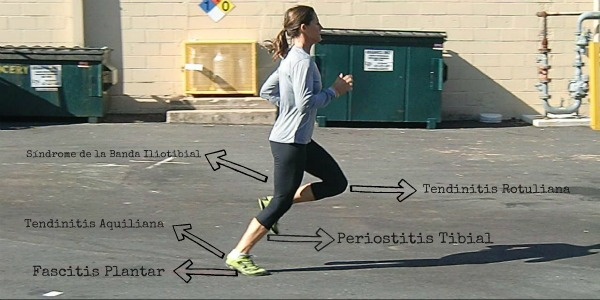
In our consultation, Both amateur and professional runners come every day not only to have us perform relief massages., but to find a solution to the problem that prevents them from continuing with their sports practice, to make that injury that has occurred and that is common in people who go out running, either as a hobby or at a competitive level, disappear..
I want to highlight in these lines three injuries that are the ones that we most frequently attend to in consultation and that coincide with those that appear with the highest incidence in runners of all types..
One of them is medial tibial stress syndrome or commonly known as periostitis.. It is common to find it among the 14 y 20% of the runners. It is defined as painful symptoms on the medial aspect of the tibia., or on the inside of the “pimple” as patients say, usually from the middle of the tibia downwards. The most common thing is to find pain on palpation at some points along this route..
 This injury usually appears at first as a discomfort that increases as we continue running., forcing us to abandon our race or training due to the acute pain it produces.
In consultation we normally find an inflammation of the muscles that insert into the middle part of the tibia., the most common muscle being the “tibialis posterior”, which is usually associated with a fall of the plantar arch.
This injury, like tendon problems, is caused by problems related to use., that is to say, due to overuse, although also due to lack of this, or for doing it too fast or too soon, which we can relate to training loads. We must be aware that “training is just as important as rest”.
Among the factors that can influence this injury, we find the type of terrain we run on, It is preferable that they be soft terrain, the type of shoe used, and the anatomical relationship between our hip, tibia and foot, which can make some muscles work more than others, causing overuse and this type of injury to appear.
Another of the most common injuries is Achilles Tendinopathy., who suffer from it around 11% of the runners. This is damage to the Achilles tendon., It can occur with inflammation in the first days or without it, causing its degeneration, being what we most frequently find in consultation.
Achilles tendinopathy is classified according to the anatomical location of the injury as insertional or non-insertional., The first being the ones that we can treat with physiotherapy with a better prognosis..
In the clinic, patients report pain in the posterior area of the heel, in the Achilles tendon, especially on palpation, and in the first steps both in the morning after waking up or when starting your sports activity, They usually comment that this pain decreases a little when they warm up and that it becomes intense again at the end of the activity., does not always force them to stop.
As causes or contributing factors we find the alignment of the back of the foot, footwear and the use to which we subject the tendon, Here we can highlight running or training on climbs, which causes overstrain of the posterior calf muscles.
The third and last injury that I am going to address is plantar fasciitis, just like Achilles tendinopathy, it is suffered by approximately one 11% of the people who are dedicated to this sport.
The plantar fascia is a wide band of connective tissue that supports the arch of the foot and is susceptible to injury with the same characteristics as those described above.. It is related to the load to which we subject this tissue, the anatomy of our foot, the use of flat shoes and the terrain where we practice the activity.
Plantar fasciitis is a common and often disabling condition, The pain it causes is worse when standing up after rest, usually early in the morning, due to the stretching that occurs when we stand up, once the patient begins to walk, the pain tends to decrease in intensity, but never completely resolves over the course of the day and is aggravated by activities such as walking or prolonged exercise, They often report intense pain after activity.
It has been suggested that plantar fasciitis represents a form of tennis elbow in the heel due to the condition being caused by repetitive micro-trauma at the insertion point..
If you are an ultra-marathon runner, The most common injuries are Achilles tendinopathy and patellofemoral syndrome., The latter normally presents with pain on the inside of the knee and can be due to different causes and will be addressed in future editions..
How do we treat these injuries??
To address this type of injuries, the most important thing is multidisciplinary treatment.
The first thing we do is listen to the patient what they tell us about their symptoms., Then we move on to the physical examination, in which we include an ultrasound study to know the state of the injured tissue and thus be able to establish the best treatment.
We normally opt for invasive treatment through the use of PPE (Percutaneous Intratissue Electrolysis) ultrasound guidance or dry needling, techniques with which we have very good results, although depending on the patient and the injury we may not include these techniques.
We combine the treatment with manual techniques so that the joint and muscles return to normal and we add an eccentric exercise program, which the patient performs both in the office and at home, in addition to recommendations about the use of cold or heat, advice about rest and the type of activity to do for optimal recovery.
The treatment and care measures mentioned will be carried out individually, taking care of each patient., according to its characteristics and those of the injury suffered at that moment.
So if you are a runner and want more information about possible injury prevention, You suspect that you may be starting one of these processes, or you already have it diagnosed and need to start treatment, Don't hesitate and contact us. We will be happy to assist you and help you continue enjoying the sport!!